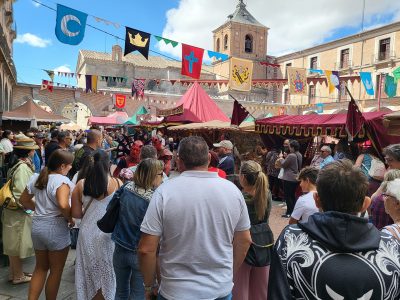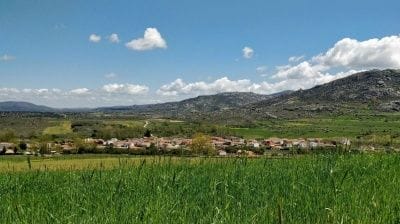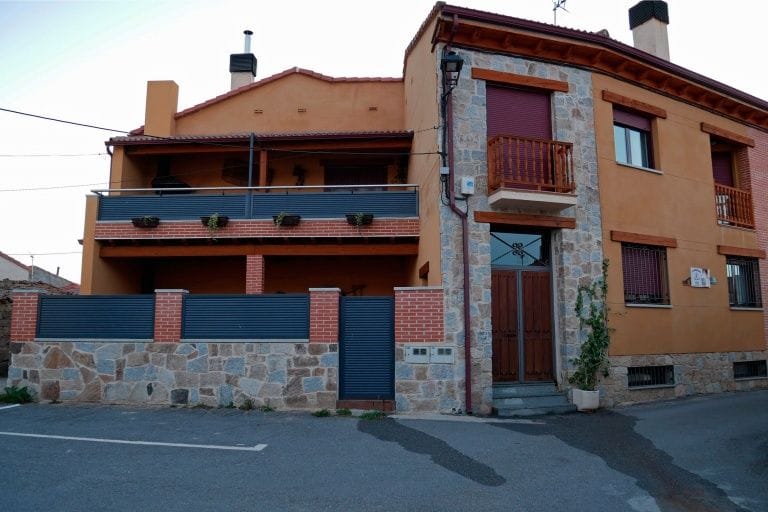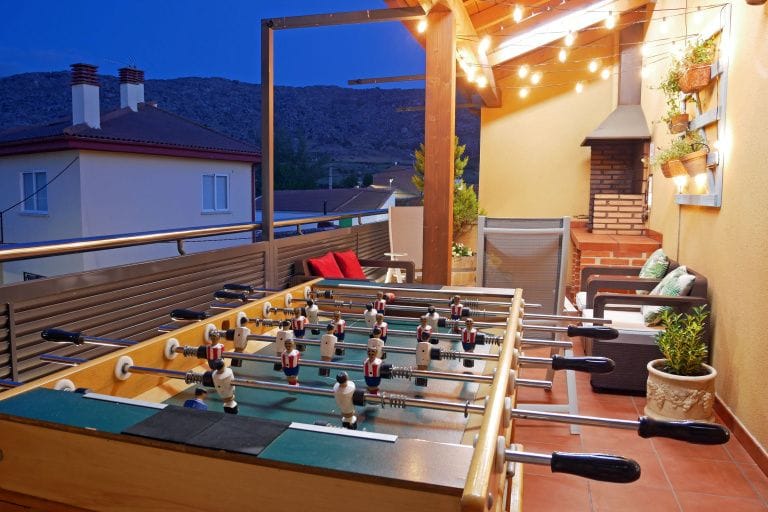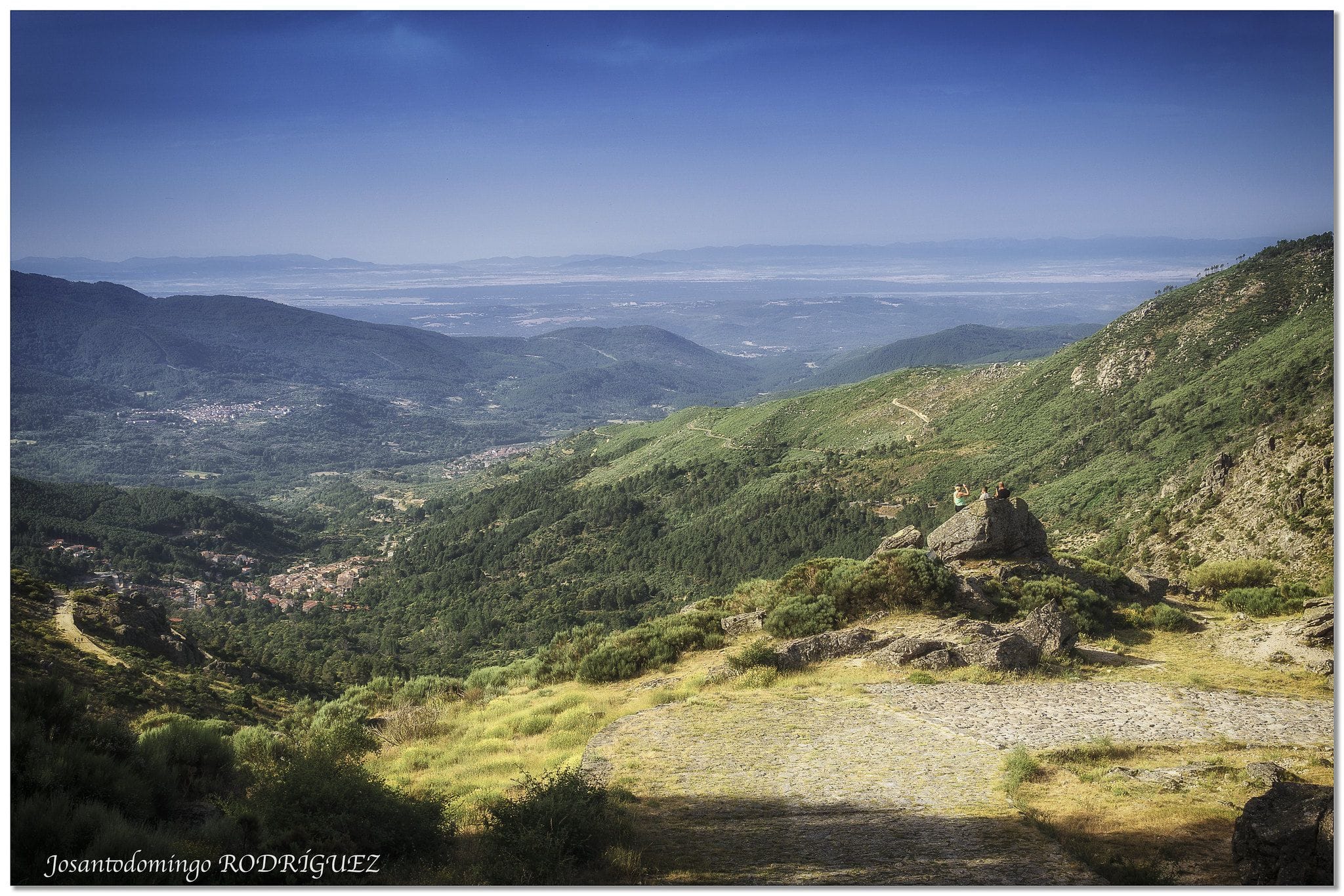
Another great day out from our cottages is the Barranco de las Cinco Villas valley and the Puerto del Pico pass.
It is a tour of five small villages full of character, through places where traditional farming is still alive: farmland and woodland, the old paths linking the villages, olive groves, chestnut trees, terraced fields, riverside vegetation and the old drovers’ road.
You can start from any of the five villages: Cuevas del Valle, Mombeltrán, San Esteban del Valle, Santa Cruz del Valle or Villarejo del Valle. Each has a trailhead information board.
San Esteban del Valle
San Esteban del Valle is a tight cluster of narrow, steep lanes floating in a sea of vineyards and olive groves. Its imposing church rises majestically above the houses huddled around the famous fountain.
- The Town Hall. Built in the early 18th century, with dressed granite walls and carved wooden eave brackets.
- Rollo. A stone column marking the village’s legal independence from Mombeltrán in 1693. It stands by the road to Santa Cruz del Valle.
- Hermitage of San Andrés. On a hillock on the way to Santa Cruz del Valle, probably 16th century.
- Cuevas del Arroyo. Old caves once used as larders, now almost all restored.
- Church of San Esteban (15th century). The nave was originally a third of its present size, with a wooden roof; it reached its final size in the late 16th century. Its south-facing Renaissance main façade stands out, and the roof is made of rib vaults on round arches, 14 m high at the top.
- El Pilón. A distinctive early 16th-century granite fountain.
- Chapel of San Pedro Bautista. Built on the site of the saint’s birthplace, in the centre of the village, entirely in dressed granite, with a round-arched doorway.


Santa Cruz del Valle
Clinging to the eastern slope, Santa Cruz has the best views of the valley; almost any street corner is an impromptu viewpoint. The murals on its façades give a unique touch to the village that was the last to gain independence from the lordship of Mombeltrán.
- Town Hall. With a library and internet centre, in the Plaza de la Constitución.
- The village is picturesque, with streets, houses, fountains and lovely corners fitted to the steep slope. You will find passageways linking neighbouring streets and low walls neatly capped with carved granite, creating a delightful maze.
- Public wash-houses, built in granite and perfectly designed for the job.
- Murals, mostly showing traditional life, on the house fronts.
- Church (16th century). Built of carefully pointed granite rubble, with a dressed-stone façade and a round-arched entrance. Stone brackets show where a large portico once stood.
- Hermitage of San José. Founded in 1876, according to the inscription over the door. Inside is an 18th-century statue of the saint.
- Rollo. A symbol of independence from Mombeltrán in 1791, carved in blue granite on a large natural boulder. Its large top piece, very different from the other columns in the valley, and its well-preserved carving, perhaps due to its relative youth, are striking.
- Viewpoint over Santa Cruz del Valle.


M3351M-T015
Mombeltrán
From the bottom of the valley, the town of Mombeltrán proclaims its noble past. The splendour of the old Colmenar (its former name) shows in the castle, the magnificent church and the many houses with coats of arms around the Corredera.
- Town Hall. In Toledo style, with a harmonious mix of rubble, rough-cut stone and brick (about 1950), on a square with a two-spout fountain and an alley under two large stone arches.
- Houses with coats of arms.
- Cruz del Rollo. Marks the granting of town status in 1393.
- Church of San Juan Bautista. 14th–15th century and a listed historic monument, with valuable 16th- and 17th-century paintings, sculptures and ironwork screens, and two ceramic altars from the same period. Architecturally, the flattened pointed arches with fine continuous capitals and the rib vaults stand out.
- Castle of the Dukes of Alburquerque. Late 15th century, rectangular with corner towers. Many details are carved in blue granite (doors, windows, battlements), standing out against the golden granite rubble walls. Inside, part of the courtyard survives, with elegant Tuscan granite columns and brick arches. The 18th-century gateway, in dressed stone with a massive, rather rough round arch, is also notable.
- Hermitage of Nuestra Señora de la Soledad.
- San Andrés Pilgrims’ Hospital. Founded in 1517, with a Renaissance doorway and a courtyard that keeps its original paving.


Cuevas del Valle
The highest village in the valley is tucked away in a small dale below the Puerto del Pico. Its streets, full of fine vernacular architecture, have seen centuries of people and livestock passing along the backbone of the valley’s history: the Roman road and royal drovers’ road.
- Church of the Natividad de Nuestra Señora, late 15th century, a Gothic building with clearly distinct later additions. Outside, the buttresses topped with ball pinnacles and the bell tower with its 17th-century brick addition stand out. The single nave has three identical rib vaults, four 17th-century Talavera tile altar fronts and a 17th-century Immaculate Conception from the school of Gregorio Fernández.
- Hermitage of the Virgen de las Angustias. A little newer than the church (1637), this small hermitage houses the patron saint of Cuevas del Valle. Inside are a beautiful Mudéjar coffered ceiling, restored in 2006, and a 17th-century Talavera tile altar front.
- Hermitage of San Antonio. Beside the Roman road stands what may be the oldest building in the village. It is thought to have been built by transhumant shepherds, which is why it is dedicated to the patron saint of livestock, San Antón. Under its brick vault hides one of the treasures of the Tiétar valley: a magnificent Mudéjar brick altarpiece.
- Rollo (pillory column). On a prominent spot near the Hermitage of San Antonio, this column marks the village’s legal and administrative independence from the lordship of Mombeltrán, granted by Charles II in 1695. It is a listed heritage monument.
- Roman road. Although the present paving is medieval, a Roman road over the Puerto del Pico is documented. It is part of the Cañada Real Leonesa Occidental drovers’ road and has been used by transhumant herds for more than 700 years, as it still is today.
- Bullring. An unusual rectangular ring with stone walls and terraced seating.
- Old Town Hall. The former town hall, restored in traditional style, now houses the library, a day centre and an exhibition room.
- Old quarter. Calle Real, Calle del Ayuntamiento Viejo and Calle de los Soportales keep all the charm of local vernacular architecture: granite ground floors topped with timber and brick upper storeys, projecting wooden balconies and deep eaves. Winding, steep streets that take you back in time.


Villarejo del Valle
Villarejo rises among olive terraces below the pine forest: traditional little streets with the Torozo peak, eternal lookout at the head of the valley, as a backdrop.
- Town Hall and medical centre. A plain building with a rubble-and-brick front on the square and a grander street façade of rough-cut stone with massive granite door frames and lintels.
- Church of San Bartolomé. 15th century, in the same style as its neighbours in San Esteban del Valle and Cuevas del Valle: an austere single-nave building of granite rubble and rough-cut stone. The simple doorway has a large round arch framed by a ball-decorated moulding. Inside are three late 18th-century Baroque altarpieces and an organ built in 1643.
- Street with fine examples of vernacular architecture.
- Hermitage of Nuestra Señora de Gracia (patron saint of Villarejo), in dressed granite, with a beautiful, symmetrical and well-proportioned porticoed façade. The capitals of the portico columns are also striking.
- Rollo. A symbol of independence from Mombeltrán in 1694, next to an 1837 fountain. It is the only column in the valley with three heads instead of four.
- Hermitage of San Antón. A small rubble building with a barrel vault, probably 17th century, with a beautiful Talavera ceramic altar inside.