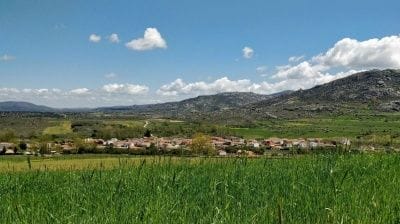
While you are staying in Robledillo, make the most of it by visiting some of the lovely towns and villages of the province of Ávila, such as Piedrahíta, El Barco de Ávila, Arenas de San Pedro and Candeleda.
Piedrahíta
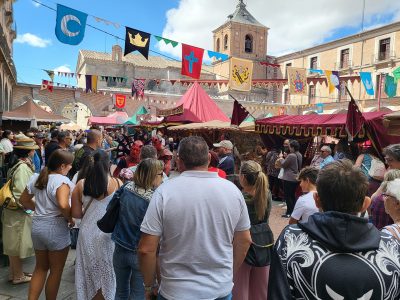
- PLAZA DE ESPAÑA: The town’s polygonal main square, near the southern stretch of the wall, is surrounded by arcades on stone columns, with granite buildings all around. The central fountain dates from 1727. It hosted all kinds of public events: tournaments, games, autos-da-fé, processions, plays, bullfights and the weekly market, which is still held every Tuesday.
- PALACE OF THE DUKES OF ALBA: The dukes’ summer residence was built on the site of the old Navancuerda castle, following the Bourbon fashion of the court. It was built between 1755 and 1766 by the Frenchman Jaime Marquet, to plans by the architect Manuel de Lara Churriguera.
- The two-storey Neoclassical palace has an entrance courtyard, service buildings and the residence with projecting side wings, plus a network of underground galleries.
- Its rear garden appears in some of Goya’s paintings, such as “The Grape Harvest”.
- CHURCH OF SANTA MARÍA LA MAYOR: According to tradition, it was built on a palace donated by Queen Berenguela in the 13th century. It was heavily altered in the 16th and 17th centuries, when private chapels were added, and has three naves with pointed arches on pillars.
- The gable keeps its original Gothic window, and some parts, like the tower, are crenellated. The doorway is sheltered by a late 16th-century portico. Inside, the Sacred Art Museum holds unique pieces such as the García de Vargas tomb, the Santa Ana altarpiece, a 15th-century carved wooden pulpit, and the screen and choir stalls.
- CARMELITE CONVENT: Founded by María de Vargas y Acebedo around 1460.
- The late 15th-century entrance has a large doorway with a stepped moulding and the Dukes of Alba’s coat of arms. The interior has been much altered, except for a rib-vaulted private chapel. It holds a work known as “El Granadino” by the painter Alonso Cano.
- RUINS OF THE CONVENT OF SANTO DOMINGO: The second lord of Valdecorneja, Don Hernando, and his wife founded the convent in the late 14th century. It is one of the town’s key landmarks, both for its cultural interest and for its artistic links with the convents of San Esteban in Salamanca and Santo Tomás in Ávila.
- In the 19th century the convent was confiscated and fell into ruin, and it was later turned into a cemetery. Of the original church, the main chapel survives, with tall pointed windows and simple rib vaulting, where the founders, Don Hernando Álvarez de Toledo, Lord of Valdecorneja, and his wife Doña Leonor de Ayala, are buried. The town archive keeps the Libro Becerro, a collection of deeds compiled by Friar Gaspar Fandiño after a fire destroyed much of the convent’s records in January 1657. Piedrahíta Town Council and the historian Raimundo Moreno Blanco have rescued these documents in a new edition.
- HERMITAGE OF THE VIRGEN DE LA VEGA: Dedicated to the patron saint of the Corneja valley. Excavations nearby have revealed, among other things, a late Roman or Visigothic villa.
- Every year the whole valley gathers on its esplanade for the traditional pilgrimage in honour of the Virgen de la Vega.
- Pilgrimage of Nuestra Señora de la Vega: first Monday after Pentecost Sunday
- BULLRING: Designed by the architect Clemente Oria and built by local stonemasons in local granite, with stone seating and a solid brick cornice decorated with granite balls.
- It houses a riding school offering country riding and traditional Spanish working-equitation lessons, as well as introductions to other disciplines.
- GABRIEL Y GALÁN HOUSE: Named after the poet José María Gabriel y Galán, who lived here while working as the town’s schoolteacher.
- It was successively the house of the Duke of Alba’s steward, a telegraph office and a clinic until, in 1875, it passed to the town council and became the public school and teacher’s residence.
- TOWER: Next to the Palace of the Dukes of Alba, known as the clock tower, to which Gabriel y Galán dedicated his well-known poem “Los dos nidos”.
Getting there
- Location: about 45 km from Robledillo
- Getting there: From Robledillo take the N-502 towards Gredos; after 6 km turn onto the AV-933 towards Muñana. At the junction with the N-110, head towards Plasencia: Piedrahíta is 30 km further on.
- Links: http://www.aytopiedrahita.com/


El Barco de Ávila
- CASA DEL RELOJ (CLOCK HOUSE): The very old town hall was demolished in the 18th century and rebuilt with carved stone and rubble walls in unmistakable Castilian style. Above the balcony overlooking the “Arvejo” are the town clock and the iron turret holding its bell.
It now houses the tourist office. - PARISH CHURCH: From the Plaza de las Acacias you can take in the granite church and its tower. On the right, the apse, topped by the bell gable of the “loose clock”, breaks its polygonal shape with a flat wall housing the sacristy and chapter house, now the parish museum. From the modern forecourt you can see the massive square tower, built at the same time as the naves in clear Romanesque style. The main door, a pointed arch between two buttresses, is on the south side.
Inside, the basilica plan has three naves ending in polygonal apses to the east, supported by outer buttresses and lit by pointed windows. A grand late 17th-century Baroque altarpiece follows the polygonal shape of the apse. - CALLE DE LA GALLARETA: The shortest, narrowest street in town, named after the farms of fine breeding cockerels that once stood here. It was also known as the “Alley of Battles”, where French invaders and Spanish fighters lost their lives.
- ROMANESQUE BRIDGE Commonly called the “old bridge”. It is not known exactly when the Romans built the first bridge here for their roads, but after so many wars and attacks it had to be rebuilt in the 12th century, taking on its present Romanesque style.
It has kept changing since then, but its Roman design can still be recognised in its seven uneven arches and wide piers of rusticated stone. The bridge is humped, rising and falling from one bank to the other. - HERMITAGE OF THE SANTÍSIMO CRISTO DEL CAÑO: It has a very old legend. Around the 13th century, a great flood of the Tormes swept a life-size wooden Christ from who knows where and left it on the left bank above the bridge. Some travellers found it and, with the villagers, carried it in procession to the parish church. The next morning it was back in the same spot; they took it to the church again, and the same thing happened the following day. Convinced it wanted to stay at the entrance to the bridge, the people built a hermitage for it there. Four centuries later it was in ruins and was rebuilt in the 17th century; while digging the foundations a spring appeared, which was channelled into a three-spout fountain. Since then both the fountain and the Christ have been known “del Caño” (of the spout).
- CASTLE: Overlooking the river and the bridge from the highest point in the valley, it stands on a Vettonian hill fort destroyed by the Romans. It was built in the 12th century and rebuilt in the 14th. In the second half of the 19th century it was turned into the town cemetery, which damaged it badly: the paving was torn up and large holes were made in the walls.
The paving and part of the keep have now been restored, and it is used for cultural events. - OLD PRISON: In 1652 the local council bought two houses on Calle Mayor from the parish to build the prison. Before that, prisoners were held in the council house and, centuries later, in part of the castle.
It is a very solid building with a wide stone staircase, a tall doorway, iron grilles and two balconies.
It later housed the local court. - CITY WALLS: As the remains show, the walls started at the castle and surrounded the old town. The present circuit dates from the 12th century and, like the walls of Ávila, Salamanca and Segovia, was built under Raymond of Burgundy, husband of the first lady of Valdecorneja. It is pentagonal in plan.
It had two Romanesque gates: the Campillo or Horcajada gate, now demolished, and the Piedrahíta or Ahorcado gate, rebuilt, with a round arch and projecting towers for defence.
There were two more gates: the Bridge gate, facing the Romanesque bridge, and the Ribera or Regadera gate. It also had three small posterns and a tiny horseshoe arch, now gone, for the town’s irrigation channel, and several round towers along its length.
Getting there
- Location: about 65 km from Robledillo
- Getting there: From Robledillo take the N-502 towards Gredos; after 6 km turn onto the AV-933 towards Muñana. At the junction with the N-110, head towards Plasencia: El Barco de Ávila is 51 km further on.
- Links http://www.aytobarcodeavila.com/


Arenas de San Pedro
- CASTLE OF DON ÁLVARO DE LUNA: built under the patronage of the constable Ruy López Dávalos. Although burned in several wars, much of it survives, restored. It has served as a prison and a cemetery, and is now a municipal auditorium, museum and exhibition and conference venue. It was declared a historic monument in 1931.
- ROYAL PALACE OF DON LUIS DE BORBÓN Y FARNESIO: Prince Luis Antonio de Borbón commissioned this palace from the architect Ventura Rodríguez in 1780, on the Mosquera hill. Because of the prince’s death only the east wing, where he lived, was built. Its main façade has a granite portico with six engaged Doric columns. Cultural figures such as the painter Goya and the composer Boccherini stayed here.
- SANCTUARY OF SAN PEDRO DE ALCÁNTARA: In a secluded spot where there was a hermitage dedicated to San Andrés del Monte, next to which Friar Pedro de Alcántara had a small convent built. It is 3 km from Arenas, following the river Avellaneda.
- PARISH CHURCH OF NUESTRA SEÑORA DE LA ASUNCIÓN: A large church in the centre of town, next to the town hall square. It was built in Gothic style in the late 14th century by order of Ruy López Dávalos, first lord of Arenas, and later works both altered and enriched it.
- HERMITAGE OF THE CRISTO DE LOS REGALAJES: On Calle Carrellana, at the start of the old Sabina road to Ramacastañas and Talavera. Its Gothic character shows in the four pinnacled spires and twisted arches. Restored in 1981, it is open on the sides and at the back, closed only by railings, so passers-by can see the statue inside.
- “ROMAN” BRIDGE: Although some signs call it “Roman”, it is a medieval bridge with a large central arch and smaller side arches, the oldest in town, known as the Aquelcabos bridge. It must have been built in the 14th or 15th century, when the town became a lordship: the toll was a source of income for the lord and the bridge helped move transhumant herds towards the Peón (Arenal) pass.
- BARRIO DEL CANCHAL: The old Moorish quarter, with traditional whitewashed houses, balconies and small windows, long an inspiration for painters. One street is still called Media Luna (Crescent).
Route details
- Location: about 45 km from Robledillo
- Getting there: From Robledillo take the N-502 towards Gredos; after about 47 km turn onto the AV-923 towards Arenas de San Pedro, 5 km further on. Continue on the same road for another 20 km to reach Candeleda.
- Links http://www.arenasdesanpedro.es/


Candeleda
- EL RASO CELTIC HILL FORT: In a beautiful setting in the municipality of Candeleda, reached by a turning off the C-501. It is an Iron Age Vettonian fort in a commanding position above the Alardos gorge, which served as its moat; its upper part is protected by a small fortress, and remains of a wall face the plain. This strategic spot controlled the lowlands and the routes up to the Gredos pastures.
It was inhabited from the late 3rd century BC until the mid-1st century BC, when it was peacefully abandoned. It was built from scratch: an earlier, unwalled village on the flat at nearby El Castañar was destroyed. The cemetery found nearby, dating from the 5th to 3rd centuries BC, belongs to that earlier village; El Raso’s own cemetery has not been found.
Excavated since the 1970s by F. Fernández Gómez, it has a 2 km wall, 2–3 m thick on average, with towers and bastions, a wide ditch in front and possibly a field of upright stones. Four areas have been excavated inside, showing dense occupation without a street plan. However, some houses follow Hellenistic models, with a central hearth and bench surrounded by the other rooms, and an entrance porch with a small animal pen. - SANCTUARY OF THE VIRGEN DE CHILLA: A sanctuary on the southern slopes of the Sierra de Gredos, much loved by the people of Candeleda.
The sanctuary dates back to the 7th century, and its present dedication to the 12th, when, according to legend, the Virgin appeared to the shepherd Finardo and brought his goat back to life. The church, in the austere Herrerian style, has a Latin-cross plan, a barrel vault and a west porch. - The convent and monastery of Nuestra Señora del Rosario.
- The Hermitage of San Blas, where the remains of the monk San Bernardo de Candeleda lie.
- The 15th-century parish church, in rural Gothic style.
- The old bridge over the Charco de la Garganta pool, built in the early 20th century.
- The ibex monument in the centre of the village, next to the Plaza del Castillo.
Getting there
- Location: about 45 km from Robledillo
- Getting there: From Robledillo take the N-502 towards Gredos; after about 47 km turn onto the AV-923 to Arenas de San Pedro (5 km), then continue on the same road for another 20 km to Candeleda.


Grutas del Águila caves
These caves formed in crystalline limestone, probably of marine origin, which was left isolated within much younger granite. They are around 50 million years old.
They are 9 km from Arenas and 3 km from Ramacastañas, where the road to the caves starts, beneath an isolated hill whose rock resisted erosion when the Tiétar trench sank.
They were discovered on the night of 24 December 1963 and officially opened to the public on 18 July 1964.
The caves consist of several irregular chambers; the main one is 20 metres high at the top of its vault. They have been only slightly adapted for visitors: over a kilometre of paved path with steps, and lighting in different colours at key points that brings out the stalactites and stalagmites in striking sculptural groups. They may be one of the most “alive” caves of their kind, as in other, better-known caves the dry ground halted their formation centuries ago.
The lighting makes the Cuevas del Águila one of the most surprising natural wonders in Spain.
Getting there
- Location: about 57 km from Robledillo
- Getting there: From Robledillo take the N-502 towards Gredos; after about 53 km, at Ramacastañas, take the turning to the Grutas del Águila.
- Links http://www.grutasdelaguila.com